The claim in circulation
A statement now circulating within the human subjects protection regulated community is this: the primary recipient of an HHS award is always engaged in the research it funds, even when it does no human subjects work itself and simply passes funds through to other institutions that do. That statement comes from a 2023 OHRP webinar [1], where an OHRP presenter stated that “even if that primary awardee is simply a conduit for the money, meaning that it doesn’t do any research activities but passes on the money to have other institutions conduct the nonexempt human subjects research, the primary institution is still engaged… even when all activities involving human subjects are carried out by employees or agents of another institution, the primary awardee is still engaged.”
On its face, this is a simple rule to apply. Read alongside OHRP’s published guidance history, however, it does not hold up.
A guidance history that is consistent until 2023
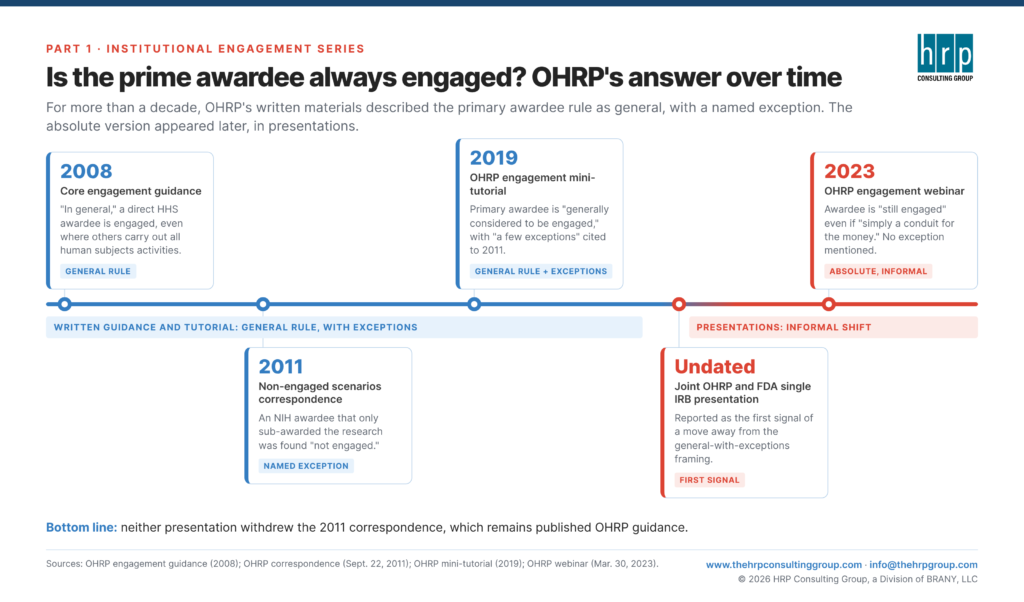
In September 2011, OHRP published correspondence [2] describing three additional non-engaged scenarios beyond its 2008 core guidance [3]. The first, titled “Awardee Institution,” involves an NIH awardee institution whose grant application described no specific human subjects research studies and whose role was limited to sub-awarding funds to other institutions that would actually conduct the human subjects research. OHRP concluded that this awardee institution was “not engaged in the non-exempt human subjects research studies that were to be carried out by other institutions under the award.” OHRP’s 2019 mini-tutorial on engagement [4] later pointed readers to this correspondence for the exceptions to the general primary awardee rule.
Every OHRP source addressing this question before 2023 states the primary awardee engagement rule as general, not as an absolute:
- The 2008 core guidance [3] frames direct HHS awardee status (its scenario A.1) as generally (not absolutely) resulting in engagement, without foreclosing the 2011 correspondence’s later exception. Notably, the 2023 webinar’s “even when all activities involving human subjects are carried out by employees or agents of another institution” language closely tracks A.1’s own text. What the webinar drops is the “In general” qualifier that introduces the list in which A.1 appears.
- The 2011 correspondence itself [2] is the exception, published and never rescinded.
- OHRP’s 2019 mini-tutorial [4] restates the rule the same way: the primary awardee is “generally considered to be engaged… there are a few exceptions to this general position… discussed in OHRP’s correspondence on non-engaged scenarios,” citing the 2011 correspondence directly.
That is more than a decade of consistent framing, from three separate OHRP sources, all agreeing that the primary-awardee-is-engaged rule is general, not universal, and all pointing to the same named exception.
Where the shift actually began
The break from that consistent framing did not start with the 2023 webinar. An earlier OHRP and FDA joint presentation on single IRB review requirements [5] appears to be the first point at which OHRP signaled a move away from the general-with-exceptions framing, ahead of the 2023 webinar [1] that later confirmed the shift in more explicit terms. Tracing the drift is helpful for institutions trying to determine how much authority the current position actually carries: this is not a single presenter’s one-time remark, but it is also not a formally adopted, written guidance position that addresses or withdraws the 2011 correspondence and 2019 mini-tutorial. It is an informal shift in emphasis across two presentations, neither of which is a superseding guidance document.
Why the distinction matters in practice
A pass-through or data-only prime awardee is a common structure in federally funded, multi-site human subjects research. NIH cooperative agreements regularly name a coordinating or lead institution that manages the award and centralizes data analysis while every actual subject-facing activity happens at sub-awarded sites. Treating that lead institution as automatically engaged, solely because of its award role, has serious implications: it requires an IRB review and approval process, and the accompanying institutional infrastructure, for an institution that has no direct contact with subjects and no independent access to identifiable information about them.
An institution in this fact pattern can document its non-engagement determination by relying on the 2011 correspondence and noting that the 2023 webinar’s contrary statement is informal commentary rather than superseding written guidance. In other words, it is reasonable to treat the 2011 correspondence, which is published, on point, and never withdrawn, as the more authoritative source.
Two caveats apply. First, the 2011 correspondence itself cautions that institutions “should not extrapolate from these descriptions and determine they are not engaged,” and the 2019 mini-tutorial [4] describes these non-engagement determinations as made on a case-by-case basis. Because OHRP’s guidance is non-binding, that caution does not prevent an institution from reasoning from the logic behind the published scenario, but an institution that does so should document its analysis carefully and recognize that OHRP may see the question differently.
Second, the 2019 mini-tutorial includes an example (Example 3) in which a primary awardee is described as engaged even though its investigator analyzes only aggregate, nonidentifiable data. In that example, however, the awardee’s investigator received the grant to conduct a multi-center clinical trial and provides logistical and intellectual support to the participating hospitals. A data-only prime awardee relying on the 2011 correspondence should document how its role differs from that example, not simply that it receives only nonidentifiable data.
The practical caveat
None of this means a pass-through prime awardee should default to a non-engaged determination without further consideration.
Remember that in any multi-site research engagement analysis, at least one institution must be considered engaged. If all other sites in a multi-site nonexempt human subjects research activity are appropriately deemed “not engaged,” the primary awardee will, by default, be engaged in the activity and responsible for ensuring appropriate IRB review and oversight. Primary awardees should also consider whether the funding agency’s grants management expectations point toward the prime awardee taking direct responsibility for IRB oversight.
In short, regardless of the strict engagement analysis, there can be good, independent reasons for a prime awardee to manage IRB review itself.
The bottom line
The claim that a primary awardee is always engaged, without exception, is not supported by OHRP’s guidance history. It reflects an informal shift first signaled in a joint OHRP and FDA presentation [5] and later stated more explicitly in a 2023 webinar [1]. Neither of these acknowledges or withdraws OHRP’s 2011 correspondence [2], which reached the opposite result on the same fact pattern and which OHRP’s 2019 mini-tutorial [4] still cited for exceptions to the general rule. Institutions facing a genuine pass-through or data-only prime awardee scenario have a documented, published, and still-current basis for a non-engaged determination, and should treat the 2023 statement as informal commentary to be weighed, not as a rule that negates OHRP’s earlier guidance.
Sources
[1] Office for Human Research Protections, webinar, “Before Saying ‘I Do’ to the Common Rule: Figuring out ‘Engagement,'” Mar. 30, 2023, https://www.youtube.com/watch?v=fcqp8BswQQM
[2] Office for Human Research Protections, correspondence describing three additional non-engaged scenarios, Sept. 22, 2011, https://www.hhs.gov/ohrp/regulations-and-policy/guidance/september-22-2011-non-engaged-scenarios/index.html
[3] Office for Human Research Protections, “Guidance on Engagement of Institutions in Human Subjects Research,” Oct. 16, 2008, https://www.hhs.gov/ohrp/regulations-and-policy/guidance/guidance-on-engagement-of-institutions/index.html
[4] Office for Human Research Protections, mini-tutorial, “Institutional Engagement in Human Subjects Research,” Oct. 7, 2019, https://youtu.be/7gmRz0dNUmI
[5] Office for Human Research Protections and U.S. Food and Drug Administration, joint presentation on single IRB review requirements, undated, referenced secondhand in a PRIM&R Connected Community (IRB Forum) discussion thread, “Interpretation of Engagement” (Oct. 2024). No link available.
Help shape the tool this analysis is building toward
HRP is launching a free practical decision tool built to help IRB offices, HRPPs, and research administrators work through engagement analyses. If you would like early access to beta test that tool, sign up here.
Questions, Comments? Let us know!
We’d love to hear your feedback! How has your institution handled thorny engagement scenarios? Is there another engagement-related topic that you’d like for us to tackle? Provide your feedback here or add your thoughts in the comments on LinkedIn.