Funding Agency Stop Work Orders: Sample IRB Guidelines for Investigators. View Now
Skip to main content

Part 1: Is the Prime Awardee Always Engaged? A Guidance History That Does Not Support an Absolute Rule

The claim in circulation

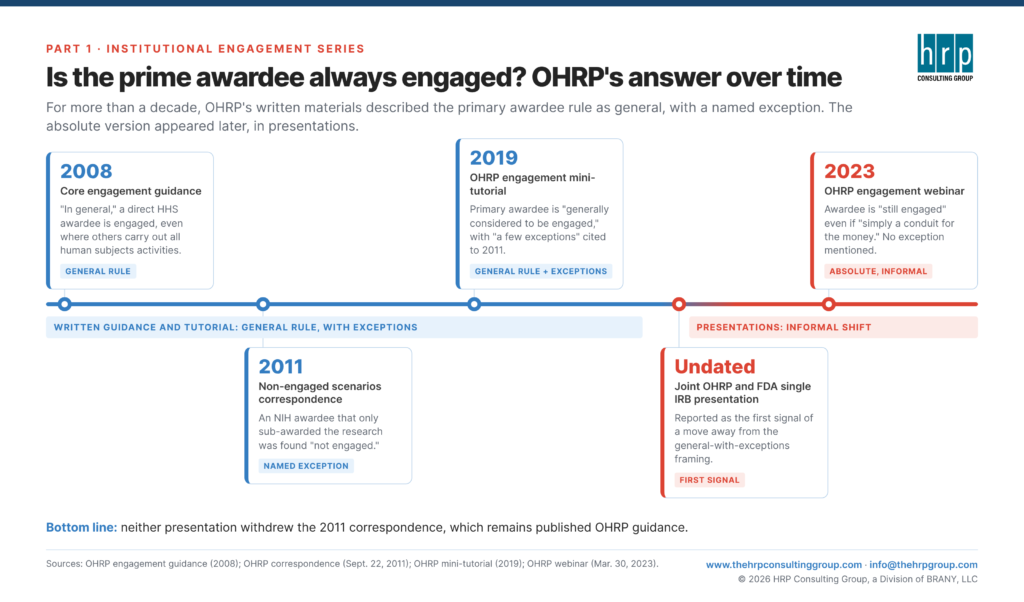
A statement now circulating within the human subjects protection regulated community is this: the primary recipient of an HHS award is always engaged in the research it funds, even when it does no human subjects work itself and simply passes funds through to other institutions that do. That statement comes from a 2023 OHRP webinar [1], where an OHRP presenter stated that “even if that primary awardee is simply a conduit for the money, meaning that it doesn’t do any research activities but passes on the money to have other institutions conduct the nonexempt human subjects research, the primary institution is still engaged… even when all activities involving human subjects are carried out by employees or agents of another institution, the primary awardee is still engaged.”

On its face, this is a simple rule to apply. Read alongside OHRP’s published guidance history, however, it does not hold up.

A guidance history that is consistent until 2023

In September 2011, OHRP published correspondence [2] describing three additional non-engaged scenarios beyond its 2008 core guidance [3]. The first, titled “Awardee Institution,” involves an NIH awardee institution whose grant application described no specific human subjects research studies and whose role was limited to sub-awarding funds to other institutions that would actually conduct the human subjects research. OHRP concluded that this awardee institution was “not engaged in the non-exempt human subjects research studies that were to be carried out by other institutions under the award.”  OHRP’s 2019 mini-tutorial on engagement [4] later pointed readers to this correspondence for the exceptions to the general primary awardee rule. 

Every OHRP source addressing this question before 2023 states the primary awardee engagement rule as general, not as an absolute:

  • The 2008 core guidance [3] frames direct HHS awardee status (its scenario A.1) as generally (not absolutely) resulting in engagement, without foreclosing the 2011 correspondence’s later exception. Notably, the 2023 webinar’s “even when all activities involving human subjects are carried out by employees or agents of another institution” language closely tracks A.1’s own text. What the webinar drops is the “In general” qualifier that introduces the list in which A.1 appears.
  • The 2011 correspondence itself [2] is the exception, published and never rescinded.
  • OHRP’s 2019 mini-tutorial [4] restates the rule the same way: the primary awardee is “generally considered to be engaged… there are a few exceptions to this general position… discussed in OHRP’s correspondence on non-engaged scenarios,” citing the 2011 correspondence directly.

That is more than a decade of consistent framing, from three separate OHRP sources, all agreeing that the primary-awardee-is-engaged rule is general, not universal, and all pointing to the same named exception.

Where the shift actually began

The break from that consistent framing did not start with the 2023 webinar. An earlier OHRP and FDA joint presentation on single IRB review requirements [5] appears to be the first point at which OHRP signaled a move away from the general-with-exceptions framing, ahead of the 2023 webinar [1] that later confirmed the shift in more explicit terms. Tracing the drift is helpful for institutions trying to determine how much authority the current position actually carries: this is not a single presenter’s one-time remark, but it is also not a formally adopted, written guidance position that addresses or withdraws the 2011 correspondence and 2019 mini-tutorial. It is an informal shift in emphasis across two presentations, neither of which is a superseding guidance document.

Why the distinction matters in practice

A pass-through or data-only prime awardee is a common structure in federally funded, multi-site human subjects research. NIH cooperative agreements regularly name a coordinating or lead institution that manages the award and centralizes data analysis while every actual subject-facing activity happens at sub-awarded sites. Treating that lead institution as automatically engaged, solely because of its award role, has serious implications: it requires an IRB review and approval process, and the accompanying institutional infrastructure, for an institution that has no direct contact with subjects and no independent access to identifiable information about them.

An institution in this fact pattern can document its non-engagement determination by relying on the 2011 correspondence and noting that the 2023 webinar’s contrary statement is informal commentary rather than superseding written guidance.  In other words, it is reasonable to treat the 2011 correspondence, which is published, on point, and never withdrawn, as the more authoritative source.

Two caveats apply. First, the 2011 correspondence itself cautions that institutions “should not extrapolate from these descriptions and determine they are not engaged,” and the 2019 mini-tutorial [4] describes these non-engagement determinations as made on a case-by-case basis. Because OHRP’s guidance is non-binding, that caution does not prevent an institution from reasoning from the logic behind the published scenario, but an institution that does so should document its analysis carefully and recognize that OHRP may see the question differently.

Second, the 2019 mini-tutorial includes an example (Example 3) in which a primary awardee is described as engaged even though its investigator analyzes only aggregate, nonidentifiable data. In that example, however, the awardee’s investigator received the grant to conduct a multi-center clinical trial and provides logistical and intellectual support to the participating hospitals. A data-only prime awardee relying on the 2011 correspondence should document how its role differs from that example, not simply that it receives only nonidentifiable data.

The practical caveat

None of this means a pass-through prime awardee should default to a non-engaged determination without further consideration. 

Remember that in any multi-site research engagement analysis, at least one institution must be considered engaged.  If all other sites in a multi-site nonexempt human subjects research activity are appropriately deemed “not engaged,” the primary awardee will, by default, be engaged in the activity and responsible for ensuring appropriate IRB review and oversight.  Primary awardees should also consider whether the funding agency’s grants management expectations point toward the prime awardee taking direct responsibility for IRB oversight.  

In short, regardless of the strict engagement analysis, there can be good, independent reasons for a prime awardee to manage IRB review itself. 

The bottom line

The claim that a primary awardee is always engaged, without exception, is not supported by OHRP’s guidance history. It reflects an informal shift first signaled in a joint OHRP and FDA presentation [5] and later stated more explicitly in a 2023 webinar [1].  Neither of these acknowledges or withdraws OHRP’s 2011 correspondence [2], which reached the opposite result on the same fact pattern and which OHRP’s 2019 mini-tutorial [4] still cited for exceptions to the general rule. Institutions facing a genuine pass-through or data-only prime awardee scenario have a documented, published, and still-current basis for a non-engaged determination, and should treat the 2023 statement as informal commentary to be weighed, not as a rule that negates OHRP’s earlier guidance.

Sources

[1] Office for Human Research Protections, webinar, “Before Saying ‘I Do’ to the Common Rule: Figuring out ‘Engagement,'” Mar. 30, 2023, https://www.youtube.com/watch?v=fcqp8BswQQM

[2] Office for Human Research Protections, correspondence describing three additional non-engaged scenarios, Sept. 22, 2011, https://www.hhs.gov/ohrp/regulations-and-policy/guidance/september-22-2011-non-engaged-scenarios/index.html

[3] Office for Human Research Protections, “Guidance on Engagement of Institutions in Human Subjects Research,” Oct. 16, 2008, https://www.hhs.gov/ohrp/regulations-and-policy/guidance/guidance-on-engagement-of-institutions/index.html

[4] Office for Human Research Protections, mini-tutorial, “Institutional Engagement in Human Subjects Research,” Oct. 7, 2019, https://youtu.be/7gmRz0dNUmI

[5] Office for Human Research Protections and U.S. Food and Drug Administration, joint presentation on single IRB review requirements, undated, referenced secondhand in a PRIM&R Connected Community (IRB Forum) discussion thread, “Interpretation of Engagement” (Oct. 2024). No link available.

Help shape the tool this analysis is building toward

HRP is launching a free practical decision tool built to help IRB offices, HRPPs, and research administrators work through engagement analyses. If you would like early access to beta test that tool, sign up here. 

Questions, Comments? Let us know!

We’d love to hear your feedback! How has your institution handled thorny engagement scenarios? Is there another engagement-related topic that you’d like for us to tackle? Provide your feedback here or add your thoughts in the comments on LinkedIn.

Introduction to HRP’s Series on Institutional Engagement

October 28

For the next three weeks, the regulatory team at the HRP Group is tackling one of the most complicated and hotly debated Common Rule concepts: engagement.  In one article each week, we work through the gray areas in OHRP’s institutional engagement guidance and offer practical tips for handling them.  In this piece, we provide context about the term “engagement” what it encompasses, and what it does not.

The Common Rule (subpart A of 45 CFR part 46) mentions engagement four times (emphasis below mine):

  • 45 CFR 46.101(a): “Except as detailed in § 46.104, this policy applies to all research involving human subjects conducted, supported, or otherwise subject to regulation by any Federal department or agency that takes appropriate administrative action to make the policy applicable to such research. […] Institutions that are engaged in research described in this paragraph and institutional review boards (IRBs) reviewing research that is subject to this policy must comply with this policy.”
  • 45 CFR 46.101(l)(4): “Transitioning research. If, on or after July 19, 2018, an institution planning or engaged in research otherwise covered by paragraph (l)(3) of this section determines that such research instead will transition to comply with the 2018 Requirements, the institution or an IRB must document and date such determination.”
  • 45 CFR 46.103(a): “Each institution engaged in research that is covered by this policy, with the exception of research eligible for exemption under § 46.104, and that is conducted or supported by a Federal department or agency, shall provide written assurance satisfactory to the department or agency head that it will comply with the requirements of this policy.”
  • 45 CFR 46.114(b)(1): “Any institution located in the United States that is engaged in cooperative research must rely upon approval by a single IRB for that portion of the research that is conducted in the United States.”

While the Common Rule tells us what obligations engaged institutions have, it does not define the term or explain which institutions are considered “engaged.”  Instead, OHRP (and OPRR before it) has attempted to clarify the meaning of this term through guidance. As we discussed in How to Read a Reg Roundup: A Short Guide to Rules, Notices, Guidance, and Dates, guidance is a tool that executive branch departments and agencies use to explain how they interpret their regulations; it generally does not bind the public or have the force of law.

This matters because, although OHRP’s engagement guidance reads as prescriptive and many institutions treat it as legally binding, institutions in fact have significant flexibility. 

Here is a comprehensive list of OHRP guidance that covers engagement.  The list ends with several OHRP-issued documents that include information relevant to an engagement analysis but that are not directly related to engagement:

Help shape the tool this series is building toward!

HRP is launching a free practical decision tool built to help IRB offices, HRPPs, and research administrators work through engagement analyses. If you would like early access to beta test that tool, sign up here.

Questions, Comments? Let us know!

We’d love to hear your feedback! How has your institution handled thorny engagement scenarios? Is there another engagement-related topic that you’d like for us to tackle? Provide your feedback here or add your thoughts in the comments on LinkedIn.


Reg Roundup 1.5: Animal Research Policy Updates + Additional Items Worth Your Attention

This final installment starts with animal research, where FDA’s move away from animal testing and new NIH requests for input could affect IACUC and Assurance practices. It then turns to additional items worth your attention, including comment opportunities on NIH’s plan to share study results with participants, an FDA request for information on early-phase ibogaine trials, and a revised Certificate of Confidentiality information collection. Several of these have comment deadlines in the coming weeks, so we note dates wherever we have them. Shorter items are grouped by agency under Honorable mention at the end.


Animal Research

FDA finalized a rule reducing reliance on animal testing. The rule replaces “animal test” and “animal study” language throughout FDA’s regulations with broader “nonclinical test” and “nonclinical study” terminology, confirming that non-animal methods, including human cell cultures, organs-on-chips, and computer or in silico models, can satisfy nonclinical safety testing requirements ahead of human trials. FDA simultaneously launched a database of 25 examples of New Approach Methodologies already in use. This did not eliminate animal studies or lower evidence standards, but it does change how sponsors and IRBs think about IND-enabling nonclinical testing ahead of first-in-human trials. FDA press release

NIH’s Office of Laboratory Animal Welfare is asking whether it should require institutions to report their annual live vertebrate animal numbers, the same way they already report facility square footage, average daily inventory, and USDA pain and distress categories in their Animal Welfare Assurance filings. The RFI specifically seeks input on current tracking methods, feasibility, implementation timelines, resource needs, and burden, for species not already covered by USDA Animal Welfare Act reporting, and any resulting annual reports would be made publicly available online. This is a meaningful potential change to IACUC and Assurance recordkeeping. Comments are due December 21, 2026. NIH Guide notice

NIH’s National Institute of Environmental Health Sciences announced a November 4 to 5 meeting of the Scientific Advisory Committee on Alternative Toxicological Methods (SACATM), the federally chartered body that advises NIEHS and the Interagency Coordinating Committee on the Validation of Alternative Methods on non-animal toxicological testing approaches. This is the advisory infrastructure behind the same non-animal testing methods FDA’s rule above addresses, and public comment registration is open through October 23. Federal Register notice

Also Worth Your Attention

NIH wants to start sharing study results directly with the people who participated in them. NIH is proposing a new policy under which researchers would share summary-level results of clinical studies with those participants.  NIH is asking for public comment on how to promote and enable this practice across the research community. Comments are due October 26, 2026. Federal Register notice

FDA laid out what it expects early-phase ibogaine trials to look like, and it is asking IRBs and others to weigh in. Ahead of federally funded trials through ARPA-H and NIDA, FDA published a request for information describing the design it is considering for first trials of ibogaine, a Schedule I drug with serious cardiac risk, in adults with opioid use disorder or PTSD: capped single doses with stepwise escalation, inpatient cardiac monitoring for at least 36 hours, detailed exclusion criteria, 12-month cognitive follow-up, and an independent data safety monitoring board with specified expertise. FDA asks directly what informed consent must say to convey “serious, potentially life-threatening risks” and what IRBs and DSMBs should consider. This is close to a template protocol for a high-risk psychedelic trial, and a rare chance for IRBs to comment on review expectations before protocols arrive. Comments are due November 20, 2026 (docket FDA-2026-N-10429). Federal Register notice | FDA press release

NIH is consulting Tribal Nations on two All of Us changes and a new Tribal Data Sovereignty Policy. One All of Us proposal would add a tier of sensitive participant data that requires mandatory IRB review before researchers can access it, a new access control for NIH’s largest cohort that other NIH data resources may copy. A second would include self-identified American Indian and Alaska Native participants in a large-scale biospecimen analysis effort, raising consent-scope and group-harm questions for previously collected samples. The Tribal Data Sovereignty Policy, still under development, would govern how NIH funding announcements, grant mechanisms, and research activities recognize Tribal sovereignty over data generated by, about, and within Tribal communities, which could add Tribal approval or data-governance terms to NIH awards that HRPPs will need to coordinate with. Consultations were held October 19 and 20; written comments from Tribes are due November 20, 2026. Federal Register notice

NIH updates its “Basic Experimental Studies with Humans” (BESH) definition. NIH’s BESH definition changes mean certain studies are no longer automatically classified as clinical trials, which changes which registration and reporting rules apply.  OHRP issued guidance on how this NIH update affects the revised Common Rule’s informed consent posting requirement (45 CFR 46.116(h)) on August 10, 2026. NOT-OD-26-067 | NOT-OD-26-032[LH3] 

ORI released new guidance documents under the 2024 research misconduct rule. Released September 29, 2026, the documents cover conflicts of interest, institutional committees, and the roles of Research Integrity Officers and Institutional Officials under the updated 42 CFR Part 93, and ORI reorganized its guidance webpage to make them easier to find. ORI guidance documents

A new information collection public comment period suggests NIH’s Certificate of Confidentiality (CoC) system might be modified. The electronic application system researchers use to obtain a discretionary CoC from NIH went down around April 30, 2025 when its prior OMB approval expired. NIH did not submit the paperwork to reinstate the collection until July 8, 2025; OMB did not approve the reinstatement until August 20, 2025, leaving the system unavailable for roughly three and a half months in between. That reinstated approval is valid through August 31, 2028. NIH submitting a new “information collection” package now, years ahead of that expiration, suggests that NIH is proposing to change some aspect of the system itself (likely something minor, but we will be able to discern more once the OIRA submission page is updated). Also of interest: In calendar year 2025, NIH saw 518 discretionary CoC submissions; in calendar year 2024 NIH received 865 discretionary CoC submissions.  We will keep an eye on whether this is a one-off decrease or a consistent trend. Comments are due November 13, 2026 (60 days after the September 14 publication). Federal Register notice

CMS proposed the RAPID pathway, a new accelerated Medicare coverage route for innovative medical technologies, relevant to any device or diagnostic research program aimed at Medicare coverage. The comment period closed October 13, 2026. Device manufacturers asked whether non-significant risk device studies, which are overseen by IRBs without an IDE application to FDA, could qualify, which would put more of the pathway’s protocol requirements in front of IRBs. Federal Register notice

Honorable mention

FDA

  • FDA opened a 60-day comment period on renewing OMB control number 0910-0130, the collection underlying its core Protection of Human Subjects and Institutional Review Boards regulations, covering informed consent documentation under 21 CFR Part 50, IRB operations and recordkeeping under 21 CFR Part 56, and Certificate of Confidentiality requests. This OMB control number dates back to 1980; its current approval was granted December 26, 2023, and runs through December 31, 2026.  This reads as a routine renewal ahead of that expiration rather than an indication that a change is being contemplated. We will know more once the record is updated on reginfo.gov. Comments are due November 30, 2026. Federal Register notice
  • FDA is surveying providers on barriers to enrolling pregnant patients in pregnancy exposure registries, aiming to improve enrollment in these voluntary observational studies that track medication safety during pregnancy. Federal Register notice
  • FDA finalized FAQ guidance on developing cellular and gene therapy products, spanning regulatory, CMC, and clinical questions in CGT product development. Federal Register notice
  • FDA sought public input on advancing botanical drug product development, relevant to anyone advising sponsors on that clinical development pathway. FDA press release
  • FDA sent OMB a revision of its expanded access collection (Form FDA 3926), the form treating physicians use to request single-patient access to an investigational drug. It adds a “planned date of treatment initiation” field. The one public comment urged FDA to use expanded access submissions as a data source, which would blur the line between treatment and research that IRBs rely on. Federal Register notice

NIH

  • NIH extended its modified peer review triage practices through January 2027, continuing the enhanced triage procedures adopted to manage a grant-application backlog. NOT-OD-26-114
  • NICHD opened a comment period on its DASH data and specimen repository, the Eunice Kennedy Shriver Data and Specimen Hub used for secondary research data sharing. Federal Register notice
  • NIAID proposed a reorganization of its Division of Clinical Research, worth watching for anyone with active NIAID-funded engagements since it could shift which office handles a given clinical research review. Federal Register notice
  • HHS opened an NIH clinic for observational research on people reporting health problems after vaccination. HHS has not yet released a protocol, enrollment criteria, or information about IRB review. HHS press release
  • NIH is operating under a continuing resolution through December 11, 2026. Non-competing awards may be issued below previously committed levels, and implementation of the revised Uniform Guidance is on hold until then. NOT-OD-26-131

Other HHS

  • OMB’s rescission package proposed cutting $27.7 million from HHS’s Agency for Healthcare Research and Quality (AHRQ), naming specific research topics as examples of work it considers wasteful or duplicative. Federal Register notice
  • CMS sought OMB reinstatement of an information collection associated with its Coverage with Evidence Development program, the mechanism CMS uses to condition Medicare coverage of certain items and services on patient participation in an approved clinical study. Federal Register notice
  • OCR’s FAQ on Part 2 substance use disorder confidentiality requirements and Medicaid cleared White House review and was released September 29, 2026. It explains when Part 2 permits state Medicaid agencies to use substance use disorder records to verify that an applicant or beneficiary qualifies for an exclusion from Medicaid community engagement requirements. OIRA detail | OCR FAQ | HHS press release
  • HRSA revised the OPTN data system collection, the forms transplant centers and organ procurement organizations use to report donor and recipient data to the Organ Procurement and Transplantation Network, including moving death-referral reporting to a separate Ventilated Patient Form. Federal Register notice

Other Fed

  • NSF sought reinstatement of its National Training, Education, and Workforce Survey, a statistical survey of the STEM training and workforce pipeline. Federal Register notice


We want your feedback!

How did we do?  Too much? Wanted more? Are there items on which you’d like for us to publish a deep-dive?  Let us know on LinkedIn or provide your feedback here.

How to read a Reg Roundup:

Inaugural Edition of Reg Roundup:


Reg Roundup 1.4: More Human Subjects and Research Oversight Announcements and Initiatives in the Pipeline

Several rulemakings and policy efforts that could change how human subjects research is reviewed and overseen are in the pipeline but have not yet been published. The FDA items below come from the Unified Agenda, so treat the target dates as forecasts rather than commitments. Knowing what is coming gives your institution time to plan, even when the timing is uncertain.


News You May Have Missed

FDA’s rule to add new IND exemptions to 21 CFR part 312 is in its final stages. This final rule would exempt certain clinical trials of lawfully marketed conventional foods (including dietary supplements) and cosmetics from FDA’s IND requirements.  An NPRM detailing the proposal and justification for it was originally published in 2022.  FDA listed in the Unified Agenda that the target publication window for this final rule was July 2026, which has already passed.  Unified Agenda entry; 2022 NPRM.

FDA intends to reopen its IRB regulations to build in Phase 1 flexibilities. A separate rulemaking would amend both 21 CFR Part 56 (the IRB regulations) and Part 312 (the IND regulations) together, building risk-based flexibilities into Phase 1 clinical trial review.  This is another Operation TrialBlazer initiative aiming to shorten the path from drug identification to first-in-human trials.  Unified Agenda entry

A broader overhaul of sponsor and investigator responsibilities under Part 312 is also in the pipeline, aimed at enhancing clinical trial quality, safeguarding participant rights and safety, aligning with global regulatory standards, and promoting trials that are representative of the populations a drug is intended for. This would touch sponsor and investigator obligations across essentially all FDA-regulated clinical trials.  The NPRM publication target is December 2026. Unified Agenda entry

Pediatric research has its own pending rulemaking. FDA is proposing new requirements for submitting initial pediatric study plans for new drug and biologics license applications, implementing pediatric study plan provisions of the FD&C Act and the Secretary’s authority to grant exemptions from those requirements. Unified Agenda entry

FDA’s rule governing electronic records and signatures is due for its own revision. FDA is planning to modernize 21 CFR Part 11, which sets the standards for how electronic records and signatures can satisfy recordkeeping and signature requirements found in other FDA regulations (referred to as predicate rules).  Part 11, as this regulation is affectionately called, causes significant challenges and headaches for people in clinical trial operations.  We are very curious about the ultimate scope of this rulemaking effort. Unified Agenda entry

NIH paused new studies in its HIV clinical trial networks. Reporting indicates that NIH told its four HIV clinical trial networks (ACTG, HPTN, HVTN, and IMPAACT) to hold off on new studies that could not finish before current funding ends in November 2027, because the renewal funding announcements, which were expected in late summer, are under review at HHS. Ongoing trials and enrolled participants are not affected. AVAC Global Health Watch | Medical Daily


We want your feedback!

How did we do?  Too much? Wanted more? Are there items on which you’d like for us to publish a deep-dive?  Let us know on LinkedIn or provide your feedback here.

How to read a Reg Roundup:

Inaugural Edition of Reg Roundup:


Reg Roundup 1.3: Hot Items (so far!) from Fall 2026

The summer items in Reg Roundup 1.2 set the direction, and fall has brought more activity along the same lines. This installment covers NIH’s plan to rewrite its Policy for Data and Safety Monitoring, FDA’s new Rare Disease Framework Initiative, and the HHS and ARPA-H SURPASS program to redesign how clinical trials are run. Each is at an early stage, so we focus on what is known so far and what to watch for next.


News You May Have Missed

NIH is preparing to rewrite its 1998 Policy for Data and Safety Monitoring. A “Draft Policy Update to the NIH Policy for Data and Safety Monitoring” request for information has been under White House review since September 29, 2026 (RIN 0925-ZA25). At a May 2026 webinar, NIH raised monitoring tiered to study risk, required components of monitoring plans, new templates, and a key scoping question: whether the policy should cover all clinical research or all human subjects research, including observational, behavioral, and implementation studies. Because IRBs must find that research plans make adequate provision for monitoring data to ensure participant safety (45 CFR 46.111(a)(6)), a broader NIH policy would show up quickly in IRB review checklists and HRPP procedures. The “draft policy update” title suggests NIH will publish proposed policy text rather than just questions. OIRA detail | NIH webinar page

FDA launched a Rare Disease Framework Initiative aimed at a “fit-for-purpose” approach to rare disease drug and biologic development. A white paper released October 14, 2026 lays out six guiding principles: more predictable decisions, the patient voice built in at defined milestones, more use of outside disease experts, shared training and resources, risk-based review of manufacturing and pre-approval inspections, and novel statistical methods. FDA says it may revise existing regulations or add new provisions to build these evidence standards into rare disease review, and it plans a systematic review of guidance on endpoints, statistical approaches, trial design, patient engagement, and post-approval obligations. The white paper does not address IRBs or informed consent. A hybrid public meeting hosted by the Reagan-Udall Foundation is set for October 28, with a Federal Register request for information to follow. FDA press release | White paper | Public meeting 

HHS and ARPA-H followed TrialBlazer with SURPASS, a multi-year program to redesign how clinical trials are run. Announced September 30, 2026, SURPASS (Simulation-augmented, Real-time Platform Adaptive Seamless Trials) funds work on “phaseless” adaptive trial designs, continuous real-time analysis of accumulating trial data, and AI-driven trial operations. Three companion efforts come with it: STACK, to make research-naive sites trial-ready through reusable agreements and shared tools; COMMONS, a national research data resource built on a “privacy-by-design” consent architecture; and CINCH, for patient-contributed real-world data. The announcement does not address IRB review, but reusable site agreements, broad-consent-style data resources, and continuously adapting protocols all raise questions IRBs and HRPPs will need to answer. HHS press release


We want your feedback!

How did we do?  Too much? Wanted more? Are there items on which you’d like for us to publish a deep-dive?  Let us know on LinkedIn or provide your feedback here.

How to read a Reg Roundup:

Inaugural Edition of Reg Roundup:


Reg Roundup 1.2: Hot Items from Summer 2026

Several developments from this summer generated enough attention on their own in trade press, law firm alerts, and conference programming that most people in this field will have seen at least a headline about one of them. While you may have read about these piecemeal, seeing these efforts described in one place highlights the volume of initiatives and the speed at which HHS and other federal agencies are moving. 

Remember: most of the dates listed in these Unified Agenda entries are aspirational and not set in stone.  If you aren’t sure how to read a Unified Agenda entry or a reginfo.gov listing, check out our companion piece walking you through these nuances here.


News You May Have Missed

HHS launched Operation TrialBlazer, a department-wide initiative to speed up and modernize clinical trials; several other items in this roundup are components of it. Announced June 22, 2026, TrialBlazer is a coordinated effort across HHS (including FDA, NIH, the Office of the National Coordinator for Health Information Technology, ARPA-H, and the HHS Office of Inspector General) aimed at reversing the trend of clinical trials moving overseas and restoring U.S. leadership in clinical research. On the FDA side alone, TrialBlazer bundles together: the Expedited IND Pilot Program covered later in this roundup; a new Phase 1 IND Navigator webpage and Phase 1 contact center aimed at smaller sponsors without large regulatory teams; draft guidance on dose selection for first-in-human trials using quantitative systems pharmacology; and a significantly revised draft guidance on what counts as substantial evidence of effectiveness, one that would let a single well-designed pivotal trial plus confirmatory evidence support approval in appropriate cases rather than requiring two independent trials. NIH’s side of TrialBlazer includes support for trials incorporating AI, human cell-based models, and real-world data, NCATS work on personalized CRISPR-based gene editing treatments, and NCI work streamlining cancer trial activation and enrollment. HHS press release | FDA actions page

Updates to the Common Rule (subpart A of 45 CFR part 46) are in active development. OHRP is working on a proposed rule to revise the Common Rule, aiming to “uphold protections for human subjects while reducing burden and ambiguity for investigators, institutional review boards, and research institutions.” The described changes include clarifying terminology, expanding exemptions for low-risk research, and building in flexibility for de minimis protocol review changes. This is currently logged in HHS’s Unified Agenda with a target NPRM date that has already passed (which is common for Unified Agenda dates). As of mid-October, the proposed rule had not yet been sent to OIRA for review. Unified Agenda entry

FDA’s single-IRB requirement for cooperative research has moved into the finalization stage. This rule would require U.S. institutions participating in multisite cooperative research to route domestic review through a single IRB, with specified exceptions, and would add recordkeeping requirements when an external IRB provides oversight. It was first proposed in 2022 and is now listed as being in the Final Rule stage in the Unified Agenda with a target publication date of December 2026.  When reginfo.gov shows that the final rule has been sent to OIRA for review, we will have a better sense of when this effort might be finalized. As of mid-October, it had not yet arrived at OIRA.  Unified Agenda entry

FDA launched a pilot aimed at speeding first-in-human trial starts, and it is one of the concrete pieces of Operation TrialBlazer described above. The Expedited IND Pilot pairs drug sponsors with “Qualified Research Institutions” and allows rolling review of IND application components rather than requiring a complete submission upfront. Sponsor-QRI pairs must apply jointly by October 30, 2026, with 8 to 10 partnerships expected to be selected, making this directly relevant to any institution positioning itself as a QRI. FDA press release

We want your feedback!

How did we do?  Too much? Wanted more? Are there items on which you’d like for us to publish a deep-dive?  Let us know on LinkedIn or provide your feedback here.

How to read a Reg Roundup:

Inaugural Edition of Reg Roundup:

Reg Roundup 1.1: News You May Have Missed + AI Policy Movement

Not every consequential federal development arrives as a headline. This article opens with four items that may have slipped past you, including a K-award change that does not take effect until 2027 and a new HHS rulemaking on graduate medical education accreditation, and then turns to the growing federal activity on artificial intelligence in research. Several of these items surfaced as blog posts, White House review listings, or Unified Agenda entries rather than formal rules, so we explain what each one is, how much weight it carries, and why it may matter at your institution.

News You May Have Missed

NIH updated requirements for its Career Development (K) Award programs, consolidating K funding opportunities into parent announcements, dropping the data management and sharing plan requirement for K applications, and barring the use of K funds to conduct clinical trials, for institutions  with active K-award recipients.  A list of current NIH K-award types can be found here.  This consequential policy change applies to applications with due dates on or after October 12, 2027, and current K funding opportunities expire by July 13, 2027 (except K00, K12, K43, and K76), so institutions have time to prepare. From what we are hearing, this change will have a disproportionate impact on smaller research programs that have a high proportion of early career investigators relying on this type of award to conduct research. NOT-OD-26-098

FDA published a Transparency Roadmap that reaches clinical research directly, and it arrived as a blog post rather than a formal notice. In an October 2 FDA Voices post, FDA committed to proactively publishing redacted Form 483s and additional inspection reports, and it named bioresearch monitoring (BIMO), the inspection program that covers clinical investigators, sponsors, and IRBs, as an area where the public has asked for more transparency. For IRBs, investigators, and sites, this means BIMO inspection findings could become publicly searchable without a FOIA request, and consent language describing who will see study data may deserve a fresh look. Implementation details are still to come; there is no docket or comment period. FDA Voices post

FDA’s successor to its Diversity Action Plans guidance appears to be on the way, under a new name and with a new focus. On October 6, 2026, FDA sent the White House a document titled “Clinical Trial Enrollment Action Plans to Improve Representation of the U.S. Intended Use Population in Clinical Studies” (RIN 0910-ZD84). The document details are not public, but the title tracks the 2024 Diversity Action Plans draft guidance while reframing “representation” around U.S. patients, consistent with FDA leadership’s stated concern about trials moving overseas. FDORA made these enrollment plans a statutory requirement for pivotal drug trials and most device studies once FDA finalizes guidance, so this document will shape sponsor enrollment plans and, downstream, the recruitment materials, eligibility criteria, and site selection that IRBs review. Unanswered questions: whether it will be issued as draft or final, and whether it keeps any demographic enrollment goals. OIRA detail  |  2024 draft guidance (background)

HHS is preparing a rule on graduate medical education (GME) accreditation, and it appears to be a brand-new initiative with no existing home in the Department. The Unified Agenda lists “Reforming Accreditation to Strengthen Graduate Medical Education” (RIN 0991-AC41) as an “Other Significant” proposed rule from the Office of the Secretary, with an NPRM target of February 2027. The abstract says only that it will “address regulations related to HHS Graduate Medical Education (GME) funding and new accrediting bodies,” and no legal authority or CFR citation has been identified yet. The title echoes Executive Order 14279 (April 2025), which directed the Departments of Justice and Education, in consultation with HHS, to investigate discrimination by medical schools and GME entities tied to the LCME and ACGME and to consider ending their federal recognition. Since then, the Department of Education has proposed a broad accreditation overhaul that would make it easier for new accreditors to gain recognition, and Secretary Kennedy has secured voluntary commitments from LCME, ACGME, and others to expand nutrition education. Our read, which is an inference and not something HHS has said, is that the likely lever is Medicare GME payment: 42 CFR 415.152 defines an approved GME program by reference to ACGME and a few other bodies “or other organization determined by the Secretary,” so a rule could open that door to new accreditors and attach conditions. Meanwhile, ACGME separately sought comment through October 22  on a major rewrite of its Common Program Requirements (a 43 percent reduction in requirements, proposed effective July 1, 2028), and the Emergency Medicine Residents’ Association reports that the draft would also loosen some work-hour protections, including cutting required rest after 24-hour call from 14 to 12 hours. ACGME’s stated rationale is burden reduction and does not mention federal action, so any link to the HHS rulemaking is unconfirmed. Academic medical centers that sponsor residency and fellowship programs should watch what HHS asks of accreditors and whether GME funding eligibility shifts away from ACGME accreditation alone. Unified Agenda entry  |  Executive Order 14279  |  HHS announcement  |  ED proposed rule  |  ACGME proposal  |  EMRA summary  |  42 CFR 415.152

NIH proposed a substantial modernization of its biosafety oversight framework. A new, comprehensive Biosafety Policy for Research Involving Biohazards would replace the current NIH Guidelines for Research Involving Recombinant or Synthetic Nucleic Acid Molecules, a framework that has governed institutional biosafety committee oversight for decades. Comments are due October 19, 2026. Federal Register notice

Federal Moves on AI in Research

Federal agencies are moving on artificial intelligence in research on several fronts at once. FDA is asking for input on how to regulate generative AI-enabled medical devices, NIH is proposing a new office to coordinate its AI policy, and ORI has issued guidance on misconduct allegations that involve generative AI. None of these items creates a new binding requirement for your institution today, but together they show where expectations for the use and oversight of AI in research are headed.

FDA is asking for public feedback on how it should regulate generative AI-enabled medical devices.  The discussion paper referenced here is more concrete than the typical early-stage RFI. It proposes a two-axis framework for risk assessment, a competency-based approach to premarket evaluation that combines device benchmarking with clinical confirmation, risk-proportionate postmarket monitoring strategies, and specific considerations for foundation models and agentic AI systems. Acting FDA Commissioner Kyle Diamantas framed the effort as part of a broader push for U.S. leadership in AI development. Comments close October 19, 2026 , on docket FDA-2026-N-7874.  CDRH’s fiscal year 2027 guidance agenda lists a generative AI guidance as “under construction,” so the feedback FDA collects here is likely to shape that guidance. CDRH FY2027 guidance agenda  |   FDA press release 

NIH proposed creating an Office of the NIH Chief Artificial Intelligence Officer, the likely future home of NIH policy on AI in funded research. The announcement is quite sparse; it’s unclear what would be under the purview of this office, how it would interact with other federal efforts on policy development here, or how quickly this new office might be launched.  Comments are due October 28, 2026. Federal Register notice

ORI provided guidance on AI usage and research misconduct. New ORI guidance addresses how Research Integrity Officers should approach cases where generative AI tools are implicated in fabrication, falsification, or plagiarism allegations. ORI blog post


We want your feedback!

How did we do?  Too much? Wanted more? Are there items on which you’d like for us to publish a deep-dive?  Let us know on LinkedIn or provide your feedback here.

How to read a Reg Roundup:

Inaugural Edition of Reg Roundup:

How to Read a Reg Roundup: A Short Guide to Rules, Notices, Guidance, and Dates

This guide is general information, not legal advice. Agency practices change, so confirm current requirements before relying on any detail below.

Our Reg Roundup covers a lot of ground in a short space. In a single edition you might see a final rule, a proposed rule that has not been published yet, a draft guidance, a request for public input, and a routine paperwork notice. They all look like “news from the feds,” but they can mean very different things for your institution or organization.

This guide gives you a quick way to evaluate any item in the roundup. For each item, ask five questions:

  • What kind of document is it?
  • Where is it in the process?
  • How much should I trust the date?
  • Does it bind my institution?
  • What, if anything, should I do about it?

Question 1: What kind of document is it?

How a federal announcement is categorized matters more than its headline. Here are the types you will see most often.

What you seeWhat it isDoes it bind you?Example from the roundup
Final ruleA regulation the agency has finished. Generally takes effect at least 30 days after publication.Yes, once effectiveFDA’s rule replacing “animal test” language with “nonclinical test”
Proposed rule (NPRM)A draft regulation published for public commentNo, it is a proposalFDA’s planned overhaul of sponsor and investigator duties under Part 312 (when published)
Unified Agenda entryThe agency’s forecast of rules it is working onNo, it is a forecastThe Common Rule revision (RIN 0937-AA16)
Request for information (RFI), discussion paper, or draft policyAn agency asking for input on a policy it has not finalizedNoFDA’s generative AI device discussion paper; NIH’s draft biosafety policy
Guidance or FAQThe agency’s recommended approach to meeting a requirementGenerally no, unless it repeats a regulatory requirementOHRP’s August 2026 FAQ on basic experimental studies and consent posting
Information collection noticeA paperwork notice under the Paperwork Reduction Act (PRA)about a form, survey, or recordkeeping requirementNot by itselfFDA’s renewal notice for control number 0910-0130

Guidance. Guidance is the category that most often trips up research compliance teams. The Administrative Procedure Act (APA) lets agencies issue interpretive rules and policy statements, which together are known as guidance, without going through notice and comment, and these documents generally do not carry the force of law (CRS LSB10591). OHRP guidance says so directly: “must” means something is required under 45 CFR part 46, “should” means it is recommended, and an institution may use an alternative approach if it satisfies the regulations (OHRP guidance). That does not make guidance unimportant. It shows you what the agency considers a compliant approach, and it is often the best predictor of how an auditor or inspector will think. It does mean you have more flexibility than many people assume; if your institution differs from published guidance, we recommend that the reasoning be clearly documented.

Information collection notices. These are the most common and least exciting items in any roundup, and the easiest to misread. A notice that an agency wants to renew or change a form is not a change to a regulation. Under the PRA, an agency generally must publish a notice with a 60-day comment period, then submit the collection to the Office of Management and Budget (OMB) and publish a second notice opening a 30-day comment period (Reginfo.gov FAQ). OMB approvals last up to three years, and an agency must seek renewal at least 60 days before the control number expires (44 U.S.C. 3507). So a notice that arrives close to an expiration date usually signals routine renewal. A notice that arrives years ahead of schedule, as we noted for the Certificate of Confidentiality system, suggests the agency wants to change something.

Question 2: Where is it in the process?

For rules, think of a ladder. The agency typically first lists the action in the Unified Agenda. It then drafts the proposal. If the action is “significant,” the draft goes to the Office of Information and Regulatory Affairs (OIRA) at the White House for review under Executive Order 12866. The proposal is then published in the Federal Register, the public submits comments, and the agency drafts a final rule, which may go back to OIRA before it is published (ICF Reg Map, 2020).

Most of what you see in the roundup sits on one of three rungs:

  • On the Unified Agenda, not yet at OIRA. The agency says it plans to act, but nothing has been sent for review.
  • Pending at OIRA. Reginfo.gov shows actions currently under review, but it does not show you the draft (Reginfo.gov FAQ).
  • Published. The proposal or final rule has appeared in the Federal Register.

Under Executive Order 12866, an agency generally may not publish a significant action until OIRA has completed or waived its review, or the review period has expired (Executive Order 12866, section 8). So if a significant rule has not reached OIRA, publication is generally not imminent. That is why we say in the roundup that the FDA single-IRB final rule is worth watching: once it shows up as received at OIRA, the timeline becomes much easier to estimate.

Not everything at OIRA is a rule. Some items on the “pending White House review” list in our roundup, such as FDA’s planned guidance on clinical trial enrollment action plans, are guidance. Whether guidance goes through White House review has depended on executive orders that have changed across administrations (CRS LSB10591).

Question 3: How much should I trust the date?

Less than you would like. A date next to “NPRM” or “Final Rule” in the Unified Agenda is the agency’s forecast, made when it prepared its entry. It is not a schedule, and it does not mean any clock has started. The agenda itself says that dates are subject to change, that agencies may act earlier or later than listed, and that the agenda creates no legal obligation to follow its schedule (2026 Unified Agenda Introduction).

A few reading tips:

  • A passed date is normal. The Common Rule entry in our roundup lists a target date that has already passed. Often, this means the work is running late, not that something has been decided.
  • Check the edition and the stage. Entries reflect the agency’s view when that edition was compiled. “Proposed Rule” and “Final Rule” mean the agency’s next step is that action. “Long-Term” means the agency does not expect action within 12 months (2026 Unified Agenda Introduction).
  • Look for a legal deadline. If a statute requires action by a certain date, that is a stronger signal of pressure on the agency than the target date, although it still does not guarantee timing.
  • Treat a month-only date as a month-only date. A date such as “12/00/2026” means the agency predicts the month and year, not the day.
  • Do not confuse comment deadlines with agenda dates. Comment deadlines, like the October 19 deadline for the FDA generative AI discussion paper, are fixed. Agenda dates are not.

Question 4: Does it bind my institution?

The general rule is that final regulations bind you once they take effect. Proposals, forecasts, discussion papers, and draft policies do not. Guidance generally does not bind your institution, except where it simply repeats a regulatory requirement. Statutes and award terms can bind you even when no regulation changes, so read the actual notice and your award terms. For example, the NIH policies related to funding might go into effect immediately, or, as with the changes to career development (or “K” awards), might go into effect in a future application or funding cycle.  Additionally, an agency can announce a change with a future effective date and later decide to implement the policy change immediately (as happened with a component of NIH’s K-award changes).

The agency’s own process offers clues. FDA, for example, generally issues a draft guidance for comment and then finalizes it, although it may implement certain guidance immediately and take comments afterward (FDA, Good Guidance Practices). OHRP follows a similar pattern for documents it labels guidance, but it may issue content-specific FAQs without a draft. A final guidance that skipped public comment still reflects the agency’s current thinking. It just has not been tested by outside input.

Question 5: What should I do about it?

After you have sorted an item, assign it to one of four buckets.

  1. Act now. The item is final or already in effect, or a deadline is near.
  2. Comment. Comment periods are one of the few ways to shape an agency’s thinking. Written comments on proposed rules go to the docket on Regulations.gov, and comments on an information collection can be submitted through reginfo.gov during the 30-day period, although comments submitted there cannot be claimed as confidential (Reginfo.gov FAQ).
  3. Prepare. The item is proposed or on the agenda, and your institution would need to change policies, training, or systems if it is finalized.
  4. Watch. The item is early, tentative, or routine. Set a reminder to check reginfo.gov, and keep an eye out for whether it appears at OIRA.

Sources

We want your feedback!

How did we do?  Let us know in the comments on LinkedIn or provide your feedback here.

HRP’s Reg Roundup: Federal Policy Announcements and Updates You May Have Missed, June to Mid-October 2026

Series Introduction

Welcome to HRP’s inaugural “Reg Roundup”! As part of our new educational content initiative, we hope to bring you these roundups regularly.  Let us know how often you’d like to see these (monthly? quarterly? more often?).

In this edition of HRP’s Reg Roundup, we summarize some of the most interesting and consequential developments in research policy at the federal level from June through mid-October 2026.  A lot has happened, so we will be publishing several articles throughout the week instead of one 5,000-word tome.

Before jumping in, check out our companion article that walks through the titillating (we think anyway…) topic of how informal rulemaking works, how to read a reginfo.gov listing, what the Unified Agenda is (and isn’t), what an “information collection” is (and isn’t), and how you can use all of the information published by the federal government to forecast what policy changes might be coming down the pike and when.

***

We want your feedback!

Please let us know what you think!  Provide your feedback here or add your thoughts in the comments on LinkedIn.

How to read a Reg Roundup

Inaugural Edition of Reg Roundup